

Federal agencies are turning informal advice into backdoor laws — and states pay the price.
Congress has the power to stop it.
Weaponized Guidance
Informal Advice,
Real Pressure
Federal agencies constantly issue letters, FAQs, memoranda, and policy statements to interpret the law and explain how they plan to enforce it.
Officially, these documents are informal and nonbinding. In practice, they often become a way to shape policy, pressure states, and regulate industry without going through Congress or formal rulemaking.
Watch CPF’s Tony Woodlief explain how this happens and why it matters for state leaders.
State leaders have an important role to play. Congress needs to hear from federalism champions who understand the real-world cost of backdoor lawmaking.
The Blueprint for Action
Research from the Center for Practical Federalism outlines how this threat to the rule of law emerged and what can be done about it.
A key part of that research was uncovering the rule change pushed through by former President Joe Biden’s Department of Justice three days before he left office, which eviscerated protections against federal agency use and abuse of guidance to target individuals, companies, public charities, schools, and other organizations. We spotlighted that change in the Wall Street Journal.
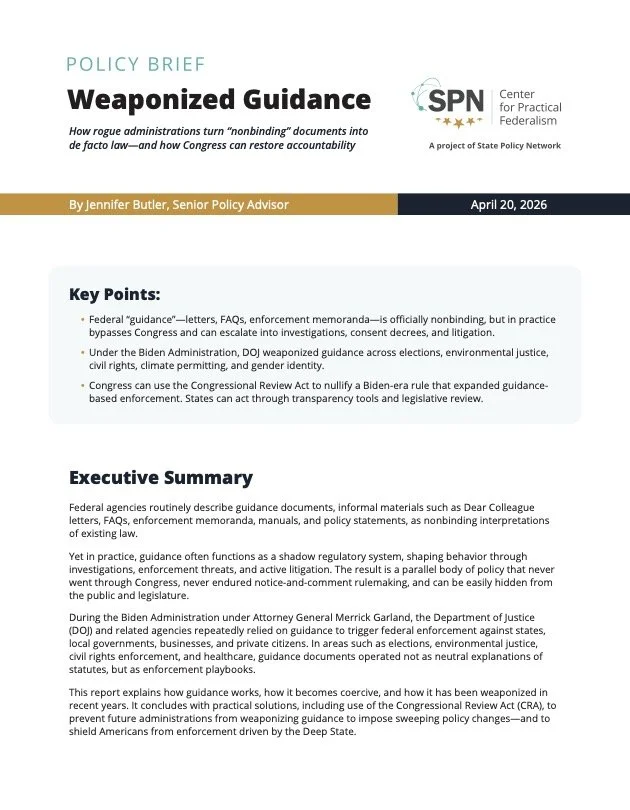
In our new report Weaponized Guidance, Center for Practical Federalism’s Senior Policy Advisor Jennifer Butler shows in greater detail how federal agencies turn informal interpretation into practical coercion. Documents that are supposed to explain existing law often end up shaping audits, investigations, settlements, and litigation, especially when states know ignoring them can trigger scrutiny.
The report shows how this pattern played out in elections, environmental policy, civil rights, climate permitting, and gender identity during the Biden Administration. It describes a system that weakens accountability, sidesteps public input, and puts new pressure on states.
Butler also lays out a practical response. Congress can use the Congressional Review Act to unwind a Biden-era Department of Justice rule that expanded this approach. States can adopt transparency and review tools that make it harder for informal federal directives to quietly drive state policy.
Key Findings
“Nonbinding” does not mean harmless.
Federal agencies use informal documents to shape behavior outside the normal lawmaking process.Interpretation can turn into enforcement.
Language from agency documents often reappears in warning letters, investigations, settlements, and court filings.This is now a repeat playbook.
The report tracks examples in elections, environmental justice, civil rights, climate permitting, and gender identity.Congress still has a tool to stop it.
The Congressional Review Act can be used to nullify a Biden DOJ “midnight regulation” that widened the use of these documents in enforcement.States do not have to wait.
Utah and Tennessee have already adopted centralized portals to catalog federal directives and make them easier to scrutinize.Lasting guardrails are needed.
A CRA resolution would prevent future administrations from weaponizing guidance for coercive enforcement and federal overreach.Transparency is a first line of defense.
States can require disclosure, legislative review, and rapid legal analysis when federal agencies try to govern through informal means.States can draw a clearer line.
The sooner they build those guardrails, the better positioned they will be to protect self-government and resist federal overreach.
This report was updated on April 20, 2026, to include additional examples. The original version, published March 31, 2026, is available here.
To schedule an interview with one of the authors, please contact Camille Walsh at walsh@spn.org.